Sign In to Your Account
Subscribers have complete access to the archive.
Sign In Not a Subscriber?Join NowClare, in Love and War
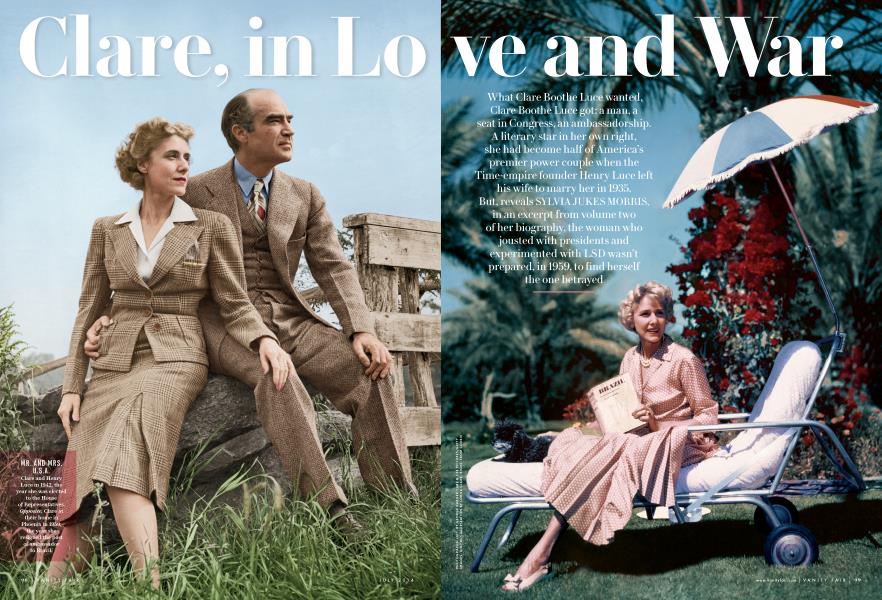
What Clare Boothe Luce wanted, Clare Boothe Luce got: a man, a seat in Congress, an ambassadorship. A literary star in her own right, she had become half of Americaâs premier power couple when the Time-empire founder Henry Luce left his wife to marry her in 1935. But, reveals SYLVIA JUKES MORRIS, in an excerpt from volume two of her biography, the woman who jousted with presidents and experimented witmLSD wasnât prepared, in 1959, to find herself the one betrayed
âTHERE IS NO JOB SO TOUGH YOU COULDNâT DO IT,â IKE SAID.
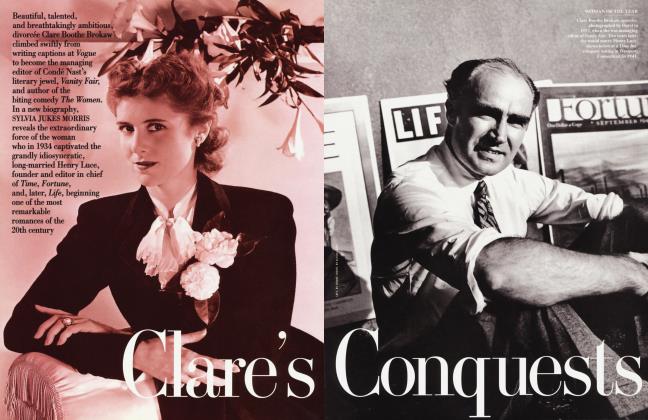
When Clare Boothe married Henry âHarryâ Luce, the 37-year-old founder of Tims and Fortune, she was 32 and already well known, as a former managing editor of Vanity Fair. Born illegitimate to poor parents, Clare was a pretty enough child actress to understudy Mary Pickford on Broadway and to act in a silent movie. In her teens she had also briefly campaigned for equal rights with the National Womanâs Party. Then she allowed her socially ambitious mother to steer her into a loveless marriage to the Fifth Avenue millionaire George Brokaw, who was more than twice her age. Six years later, in 1929, now a well-off divorcee with a five-year-old daughter, Clare launched a lifelong series of male conquests, starting with the Wall Street speculator Bernard Baruch. Conde Nast, who was infatuated with her, employed her at Vogue and later Vanity Fair. An early writing assignment at the latter was a 1930 âHall of Fameâ profile of Luce, who in 1935 left his wife and two sons for her. The following year,Clare became even more celebrated as the writer of the all-female Broadway play The Women. She would eventually write eight plays, three books, and several movie scripts. For almost three decades, the Luces were indisputably Americaâs foremost power couple. Clare covered the early days of World War II in the Far East and Europe as a correspondent for Life, her husbandâs picture magazine, then served in Congress as a two-term Republican representative from Connecticut. As the only female member of the House Military Affairs Committee, she twice toured the Italian and French battlefionts and hadliaisons with at least two generals. The devastating death of her only child, Ann, in an auto accident at age 19, drove Clare to convert to Roman Catholicism (with the help of Reverend Fulton J. Sheen) and later to experiment with psychedelic drugs. As a formidable television campaigner, she helped Dwight D. Eisenhower win a landslide victory over Adlai E. Stevenson in the presidential election of 1952. Shortly afterward, a summons came for Clare to meet the president-elect at his transition headquarters in New Yorkâs Commodore Hotel, a meeting she carefully recorded.
Adapted from Price of Fame: The Honorable Clare Boothe Luce, by Sylvia Jukes Morris, to be published this month by Random House; Š 2014 by the author.
Presidential Favor
At the hotel, she found a warren of offices swarming with job seekers. Then Eisenhower emerged and strode toward her, smiling broadly with outstretched hands. He ushered her into his suite and closed the door. She was struck, as often before, by the âsheer vitality of the man, and his essential simplicity and goodness... with that warmth and cheerful heartedness and self-possession that inspire love and confidence in everyone.â
Their conversation began with pleasantries about her influential husbandâs role in the campaign. Eisenhower then changed the subject, saying he would like to appoint a Catholic as his secretary of labor. What did she think about that? Clare said he would need someone of âtremendous capacityâ for such a demanding job.
âThere is no job so tough you couldnât do it,â Ike said.
While she digested this compliment, he remarked that she was âcertainly smarter and ablerâ than Frances Perkins, the first woman to hold any Cabinet post. Clare was even more flattered but, knowing from congressional experience that she had no propensity for dealing with unions, said she felt unqualified.
Eisenhower asked if there was another job she would prefer. Clare suggested tentatively that she could be a successor to Eleanor Roosevelt as chairman of the United Nations Commission on Human Rights. He looked surprised and said that would not be âmuch of a thing.â In any case, the post was filled.
Edging closer to candor, Clare said she âfit nowhere except into the field of foreign affairs.â Before Ike could reply, she added, âAnd with London gone to Aldrichââ
âWho told you that?â he snapped.
âEveryone in New York knows, because the Aldriches have leaked it.â
He laughed and said Winthrop Aldrich was âthe brainiest man with the least wisdomâ he had ever encountered. It was true, however, that the former banker had been appointed to the Court of St. Jamesâs.
Continuing to press, Eisenhower asked, âWhat would you like best?â
Clare knew there was only one answer. Mysteriously and often over the years, Italy had summoned her, first when she had been a correspondent for Life in 1940, then twice more, when she visited American and British troops in 1944 and 1945, and had repeatedly met Pope Pius XII. Since the end of the war, she and Harry had been as concerned over the threat of Communist expansion in Italy as in China. They had helped orchestrate the successful fundraising visit to the United States of Alcide De Gasperi, Italyâs postwar architect of Christian capitalist democracy. He was still in power and deeply grateful to them.
Eisenhower was waiting to hear what reward she wanted, so Clare took the plunge. âNaturally, what I canât get. Rome.â
âWho told you you canât get it and why?â
âThere are so many others to whom you are obligated.â
At this point, she cast aside false modesty and cited three benefits he might gain in choosing her. First, he would gratify the millions of Catholics who had voted for him; second, her appointment would save him from having to send another of her faith to the Vatican; and, third, every female in the electorate âwould be pleased that a woman had finally got a number one diplomatic post.â Left unspoken was her dismay at the growing presence of Communists in Italyâs government and industries.
Eisenhower hedged. He wondered if she might have a second choice, such as Mexico. âYou could do a splendid job for me there.â Clare said lamely that it might be an easier commute. Still probing, Ike asked how her husband would feel about her going to Italy. She admitted that they had discussed it, and Harry liked the idea. Time Inc. had a bureau in the Eternal City, so he could visit her and run his business from there. She did not have to remind Eisenhower that with their combined wealth they had ample means to finance the entertaining expected in a prime ambassadorial spot.
He brought the discussion to an end without committing himself, but gave her a caution that sounded like encouragement. âPlease donât discuss this with Foster.â John Foster Dulles, as Clare knew, was his choice as secretary of state, and, as a staunch Presbyterian, was unlikely to favor a Catholic woman in the Rome embassy.
âLet me wangle it, and be patient,â Ike said.
As if on cue, Dulles entered. After a brief chat, she left with the impression that if he agreed to have her in his diplomatic corps she would get her heartâs desire.
HARRY CONFESSED HE HAD BEEN SLEEPING WITH JEANNE CAMPBELL GRANDDAUGHTER OF LORD BEAVEBBBOOK.
HARRY CAME HOME TO FIND THAT CLARE HAD TAKEN AN OVERDOSE OF SODIUM AMYTAL.
In a letter that night, Clare shared every detail with Harry, who was on a business trip to Asia. Seeking to assuage whatever disappointment he might feel at not having been favored himself, she told him that she disliked the prospect of their having to pursue separate careers on different sides of the Atlantic. âThe awful apartness... fills me with panic, vertigo, anguish beyond reason when I contemplate it.â They must thrash it out as soon as he returnedâthe implication being that she hoped Harry would reassure her that their marriage could stand the strain. In the meantime, âmy poor, thirsty little (no, big) ego has had the healing draught it needed most.... I am so very happy because I feel recognized, appreciated, wanted... by the one man whose recognition and appreciation matter most in politics.â In a dozen ways, she added, Ike had made it clear that âin honoring the wife, he sought to honor and please the husband!â She reminded Harry, in a postscript, of his importance around the globe. âGosh darling, in the tragic environs of Korea and Formosa, does all this soundâtrivial and selfish? And irrelevant?â
After years of marital crises and exhausting reconciliations, their mutual support of Eisenhower and shared interest in Cold War politics boded salvation for them both. They were now in a position to try to influence policy as well as comment on it.
Her true excitement showed in a note to a friend at Vogue: âMaggie, I want Italy more than anything in my entire life.â
On December 17, 1952, Clare heard that she had been nominated Ambassador Extraordinary and Plenipotentiary to the Republic of Italy. As the first woman ever to hold such an important diplomatic post, she spent three and a half years in Rome and distinguished herself there despite opposition from chauvinists in her own embassy as well as Communists in Italian industry and the government. Her major achievement was to help settle the intractable Trieste crisis, which threatened to bring about war between Italy and Marxist Yugoslavia. In 1959, Eisenhower appointed her ambassador to Brazil, but in the congressional hearing to approve her, she crossed swords with the truculent senator Wayne Morse, of Oregon, who opposed her so aggressively that, although confirmed by a large majority, Clare felt compelled to resign the post. Far from being cast down, she embarked at age 56 on an exhilarating new experience.
Sex, Lies, and Hallucinogens
At 11:25 A.M. on May 16,1959, at Sugar Hill, the Lucesâ 20-room, Georgian-style house in Ridgefield, Connecticut, Clare took 100 micrograms of lysergic acid diethylamide. Two friends from California, the writer-philosopher Gerald Heard and his musician partner, Jay Michael Barrie, supervised the dose. It was her third experience in three months with LSD, as the new hallucinatory dmg was known.
By 11:55 she was gazing out the window âwith great stillness and intensity,â Barrie noted as recorder. They had been listening to Sibeliusâs Symphony No. 2, and when it ended, Clare said, still staring at her lawns and flowering dogwood trees, âItâs hard to tell whether the music was accompanying that out there, or that out there was accompanying the music.â
At 12:10 she protested that Stravinskyâs Renard was âa vast intrusionâ on her contemplation and should be turned off. âThe trees, if they knew what they were doing, would be making their own music.... The colors are beginning to separate themselves into all their exquisite subtleties.â
Soon her mood changed again, and she requested that a bowl of lilacs be brought to her. She focused closely on the blossoms and said, âNow Iâm beginning to see the flowers breathe. It makes one yearn to see God.â
The sound of an automobile horn outside announced the arrival of Harry for lunch. âI shall leave you three to wrestle with the spaghetti,â Clare said. While the men ate, she remained on the porch, drinking a cup of broth. Then she went out, spread a blanket on the lawn, and lay down.
By 6:15 the effects of her trip had worn off. She joined her husband and guests for dinner and the kind of cerebral conversation with Gerald that she relished. She had met him in 1947, while working on a screenplay in Hollywood, and had been captivated by his Anglo-Irish charm, emdition, and spirituality. The author of more than 30 books on science, religion, philosophy, and Eastern mysticism, Heard had immigrated to America with Aldous Huxley in 1937. He had become a devotee of the Hindu guru Swami Prabhavananda, and after World War II had emerged as something of a gum himself, founding the monastery-like Trabuco College of Prayer, in the Santa Ana Mountains.
His interest in liberating âthe inner manâ had led him in 1954 to experiment with Huxley in taking mescaline, a psychedelic derivative of cactus plants. The following year he had moved on to experiment with LSD. Not being an accredited scientist or physician, Heard had to obtain his supplies from a friend, Dr. Sidney Cohen, chief of psychosomatic medicine at the Veterans Administration Hospital in Los Angeles. The doctor was administering a federal program to investigate the drugâs potential in treating psychotics and criminals but was also interested in its effect on creative and highly intelligent people, such as Clare Luce.
Feeling revitalized after three mostly pleasant acid trips, dare began a three-month literary sojourn on the Caribbean island of St. John. Her intent was to work on her memoirs, but she found introspection into her painful past daunting and got no further than a brief outline. She gave up in favor of writing a detective novel set in Brazil, and at first the prose flowed effortlessly. She told Heard that her facility must be due to the prolonged effects of LSD.
Letters arrived at the island from Father John Courtney Murray, professor of Catholic Trinitarian theology at Woodstock College, a Jesuit seminary in Maryland. He was Clareâs spiritual adviser. During her time in Italy, he had also become a golfing buddy and confidant of Harryâs, and now wrote to say that her husband was experiencing an unspecified emotional crisis.
On September 19, on the first of what Clare described as several âagonized nightsâ of marital confrontation, Harry confessed that for the past three years he had been seeing and sleeping with Lady Jeanne Campbell, granddaughter of the British press mogul Lord Beaverbrook.
Now 30, Jeanne was a more mature version of the tall, peachy-cheeked 20-year-old Clare remembered from staying with Beaverbrook in Jamaica in 1949. Since the young womanâs parents had divorced early, she had seldom lived at Inveraray Castle, the ancestral home of her father, Ian Campbell, Duke of Argyll, in Scotlandâs Western Highlands. Instead, she had stayed at her grandfatherâs multiple establishments, dabbling in acting and having a fling with the Fascist Sir Oswald Mosley. Harry had met Jeanne again at Beaverbrookâs villa on the French Riviera and become besotted with her.
âMOST MEN DO NOT KNOW WHAT LOVE IS, BECAUSE THEY DONâT EVER
LOVE AS EQUALS."
But it was not until September 1956, while Clare was winding up her ambassadorship in Rome and Jeanne was working as a photo researcher in New York at Life, that Harry had seized the chance to mate his fantasy a reality. He had dined with her a couple of times in his Waldorf Towers apartment and made a tentative pass. Then, in early January 1957, after he had spent several weeks in Italy with dare, they had what Jeanne characterized as âan explosive coming together,â declaring and consummating their love. He was the âcuddlyistâ man in the world, Jeanne told an office colleague, âbut it took him six months to get it up!â
When they were apart, which was often, because the Luces now had a winter home in Phoenix, Arizona, Harry wrote, telephoned, and sent so many dozens of roses that Jeanne ran out of vases.
On March 15, 1959, afraid Harry might be happy to continue indefinitely with their irregular, clandestine couplings, Jeanne proposed marriage. She felt an urgent need to have children, and asked that he try to alleviate what he called his sexual âinadequacyâ by having his prostate fixed. She then left for Europe, setting a deadline of July 15 for him to accept or reject her proposal. If the former, she expected him to begin at least separation proceedings. Harry agreed to her proposal in writing and went ahead with the operation.
Clare now discovered that he had been dallying with his âgirlâ during a business trip to Paris, on the assumption that the Luces could agree to a separation pending divorce. In a further blow, Harry announced that he had not really loved her for 20 years and had stuck with her primarily because he was âsorryâ for her. But since she had seemed âso well, so happy, so confidentâ lately, he felt that he too âhad the right to happiness.â
His betrayal and condescension were bad enough, but as Clare absorbed the longevity of his deceit, her fury grew. For two decades the man standing before her had feigned impotence, when all along it had been his revulsion to her body that caused his incapacity. He had a nerve assuming she would accommodate his current wish to dump her. This was a moment to take a cue from The Women, written 23 years earlier: âWhat has any woman got to gain by a divorce? No matter how much he gives her, she wonât have what they have together.â
She put this to Harry, but it left him unmoved. âMy girl,â he informed her, âwill fight for me.â Evidently âthe Lady Jeanne,â as society columns called her, was a determined young woman. Clare bounced an ashtray off Harryâs balding head and followed up with a torrent of gutter language. His penchant for Jeanne, she said, was âall sex,â in contrast with their own 20-year lack of it.
Harry denied that his relationship with Jeanne was one-dimensional, and claimed that it was âthe last great loveâ he could expect. Yet he admitted in the same breath to suffering from âpost coitus triste. â Clare attributed this sadness not only to Calvinist guilt but also to egotistic regret that the possession of his partner had been rushed or incomplete. âOrgasm,â she told him, was not âthe sole and final end of sex.... There can be in one gentle kiss, one generous caress, one entwining of fingers more sexuality than in a whole whorehouse.â
As the confrontation wore on, Clare suspected that Harry saw her as his jailer and wanted her dead. He intuited her misery and, in a conciliatory gesture, took her in his arms. He said âa love deeper than loveâ existed between them. âI can never leave you, if you cannot bear it.â
The following night, Harry had a colloquy with Father Murray. He said he could not forsake âthis pitiful woman,â and might have to âsacrificeâ Jeanne for his wifeâs âgreater need.â
On Saturday, September 26, in a state of exhausted armistice, the Luces were having dinner a deux at Sugar Hill when Harry was summoned to the telephone. The caller was Igor Cassini, alias the gossip columnist âCholly Knickerbocker,â of the New York JournalAmerieanâWiWism Randolph Hearstâs biggest scandal sheet. Cassini asked Harry to comment on reports that he and his wife were separating.
Taken aback, Harry said, âClare and I are here together. It is all very premature, to say the least.â After a short pause, during which he realized he had given credence to the rumor, he blustered, âThere is nothing to it at all.â The result was a headline story on Sunday morning, illustrated with a photograph of a bravely smiling Clare.
The Big Topic in the Intelligentsia Set as well as in the Smart Set these days is that Henry Luce, publisher of Life, Time and Fortune, and his talented wife Clare, onetime playwright, Congresswoman and U.S. Ambassadress to Italy, are planning a separationâor a divorce. Reports reaching this reporter from London and Paris, where Luce visited recently, say that the powerful publisher has admitted to intimate friends that he and his wife intend to separate.
Luce has been often seen in the company of the lovely Lady Jean [sic] Campbell, daughter of the Duke of Argyll and granddaughter of a fellow-publisher, Englandâs omnipotent and vociferous Lord Beaverbrook.
On the weekend of October 10, as Harry discussed his marital options with his sister Beth and brother-in-law Tex Moore, an attorney, the two women vying for his affection addressed urgent appeals to him. Jeanne Campbell cabled from London: âLots of anyway [.v/t ] love and thoughts for my beloved grumpy growly friend.... Think and think hard. Your Jay.â
Clare wrote him from San Francisco, where she was making a Columbus Day speech. She offered a significant concession. Though she had âa legal holdâ on him, she did not wish to exercise it. âYou are free to marry Jeanne or notâas you choose. If this is the only way for me to prove that underneath it all I bear you more goodwill and love than I have ever borne anyoneâyou have that proof. I could not face the declining years of my life with you, knowing that you shared them with me only as a prisoner.â
She knew Jeanne was due back in New York and said that, since Harry would probably want to see the young woman, she would await his decision in Phoenix.
Clare next heard that Harry had âcapitulatedâ to his familyâs insistence that a divorce was far too drastic a solution. It would threaten his childrenâs inheritance and damage his reputation as a person of probity. The ensuing scandal might alienate millions of Catholics sympathetic to Clare and adversely affect the value of Time Inc. stock. His lawyer therefore recommended a legal separation.
Logistically, the moment for such a move was ripe, because the Luces had sold their 52nd Street duplex and were about to take another apartment at the Waldorf Towers. However they resolved the question of who might occupy it, Harry would have legal freedom to be with his mistress whenever he wanted, while his wife could depend on financial support to continue in her customary style.
Although Clare had promised to accept any decision Harry made, the prospect of his flying to Arizona with actual documents for her to sign was apparently too much to bear. While he was en route, she swallowed a large quantity of sleeping pills. As fateâor her own survival instinctâwould have it, Father Murray was staying with her and called for emergency help.
By the time Harry arrived, she was recuperating. He now had to face the possibility of a recurrence, should he go ahead with the separation plan. So when a newsman called on October 19, asking about reports that he was in Phoenix to break with his wife, he said, âThereâs nothing to it, this report of divorce.â
Later that morning, when he returned to the Phoenix airport, Clare was at his side.
Harry called Jeanne and told her to leave New York at once. He was afraid of his wifeâs fragile emotional condition. âI donât care where you go, but get out of town.â
On November 6, the Luces left for a week in Hawaii, where Harry was opening a Time Inc. office. Before the war, they had been enchanted by Oahu, and he had promised to look for âa little palace by the waters,â where Clare could swim and surf. His search had been unsuccessful. They agreed to look again, seeing it as a fresh venture for them both. Before they headed for the mainland, Harry told Clare that he âno longer wanted a divorceâ and preferred to âgo down the long roadâ with her.
In February 1960, Gerald Heard and Jay Michael Barrie joined Clare in Phoenix for what Heard described as a âwonderful weekâ of LSD. This time the experiments were scientifically administered by Sidney Cohen himself. Harry too took a doseâhis first. He was slow to âgain orbit,â but when he did, he sauntered out into the garden, where he claimed to hear beautiful music. Standing among cactus plants, he began conducting an orchestra visible and audible only to himself.
For once, Clare did not have a happy experience with the drug. She imagined that Cohen had âheld up a mirrorâ to her, and she so disliked what she sawââa rejected, jailed
womanââthat she cried in front of him.
Before returning to New York, Harry swore on the Bible that it was his âsolemn intentionâ to stay married to Clare for life. Then, on February 29, he surprised her by phoning to say he was coming to Arizona again the following day Despite his biblical vow, he now said that he did not love her, still loved Jeanne, and wanted to negotiate a âconcordatâ that would enable him to have his âlast chanceâ to âdominateâ someone. He said he needed to see Jeanne again so that he could mate up his mind.
KENNEDY SAID HE DISLIKED HAVING CLARE LUCE TELL HIM âHOW TO RUN THE WORLD.â
On or about May 16, dare got a letter from Harry assuring her that âthe Final Encounterâ had taken place in Paris, and he had told Jeanne that he was staying married. Surprisingly, she had shed few tears. Clare wrote at once to congratulate him on his âastonishing ability to get everyone... to see things your way.â
At the end of a nine-day Caribbean vacation, Clare re-united with Harry in New York for the Memorial Day weekend. She soon found out that he had been tying to her about breaking off completely with Jeanne Campbell. In fact, he had taken her from Paris for a week-long car tour of Switzerland. This revelation, plus anotherâthat he had told Jeanne he âwould marry herâ if he ever got a divorceled to long hours of acrimonious argument, with Clare yet again trying to get Harry to say what he wanted, and he, as was his habit, asking her to decide what he should do. By late Monday night, both of them were exhausted, and she went to bed. Around 12 oâclock, he came into her room and said portentously, âIt is Godâs will. You are the cross I have to bear.â
At the end of her tether, Clare picked up the telephone. She dialed the Waldorfâs Western Union office and dictated a telegram:
JEANNE CAMPBELL, INVERARAY CASTLE, ARGYLL, SCOTLAND. HARRY SAYS THAT HE WISHES TO MARRY YOU AND THAT HE WILL SOON BE IN THE POSITION TO DO SO. CONGRATULATIONS. CLARE LUCE.
Harry, outwitted and furious, called the operator back and asked her to cancel the wire. He was told that only the sender could do that, so he fired off one of his own: DISREGARD TELEGRAM FROM CLARE.
A month later Jeanne, trying to stay optimistic, looked for a house in Jamaica where she and Harry might live. She was therefore flabbergasted to receive a letter from him, telling her yet again they could not marry. He gave no explanation except to say that Clare had made an âunseriousâ threat to jump from their 41st-floor apartment.
Jeanne was in New York by early July, as was Winston Churchillâs tempestuous son, Randolph, a close friend of hers and Clareâs to America by the New Statesman to cover the two presidential conventions being held that month. While the Englishman was in Manhattan, Jeanne let him stay with her in a small rental apartment.
The Democrats convened in Los Angeles on July 11, and four nights later Joe Kennedy arrived at the Lucesâ suite to watch his son John accept the nomination, after a last-minute challenge by Senator Lyndon B. Johnson. âWe stand today on the edge of a New Frontier,â the charismatic young candidate said, âthe frontier of the 1960s.â
A week after that, Randolph boozily inveigled himself into a dinner Clare was attending with the former heavyweight boxing champion Gene Tunney, at the new Four Seasons restaurant, on Park Avenue. She managed to have him seated far from her, because of his habit of loudly proposing marriage every time they met. To avoid having him escort her home, she slipped out early, on the pretext of going to the ladiesâ room. But in the street, as she hailed a taxi, Randolph came flying out, pursued by Tunney, and jumped into the cab with her. It moved off, and Tunney ran alongside, shouting to the driver, âI am Gene Tunney. You get this lady back to the Waldorf at once, safety, or you will be hearing from me!â
As Tunney fell behind, Clare became aware that Randolph was moaning. âWhatâs the matter with you?â she asked. âIâm going to sue,â he said. In the chase out of the restaurant, Tunney had apparently given him a kidney punch.
She shot out at the Waldorf and, leaving Randolph to pay, headed upstairs, telling the desk clerk not to admit Mr. Churchill under any circumstances. Randolph was reduced to phoning her and begging her to side with him in the event that he brought suit against Tunney. She assured him that, on the contrary, she would be a witness for Gene.
Farce quickly turned to near tragedy later that night when Harry came home to find that dare had taken an overdose of sodium amytal. In all likelihood, Randolph had told her with his usual blunt honesty that he was staying with Lady Jeanne Campbell. The shocking news that Jeanne was back in townâno doubt at Harryâs urgingâmade Clare realize that her husband had betrayed her yet again.
She was rushed to Doctors Hospital, on East 87th Street, to be pumped out. Harry issued a statement that his wife had suffered âa digestive disturbance.â In an agony of contrition, he sent her a handwritten apology. âI want to go on with you because I have loved you very deeply and I do love you.â
Lady Jeanne Campbell eventually married the novelist Norman Mailer, who fathered her long-desired first child, Kate. But the marriage ended after a year.
Clare at Camelot
In early October 1960, John Kennedyâs Catholicism became a potentially serious liability in his election campaign against Richard Nixon. Clare received a call from an agitated Joe Kennedy, asking her âto do Jack a big favor.â He complained that, everywhere his son held a rally, swarms of nuns were settling in the front seats, âclicking their rosaries and their denturesâ in excitement. Joe thought Cardinal Spellman might be able to do something about it, but he could not approach His Eminence. âThe S.O.B. hates me. I beat him out of some real estate,â he said, chuckling. âBut you could tell him, tactfully, that if he wants a Catholic in the White House, heâd better keep those goddam nuns from hogging all the front rows. This isnât an ordinationâitâs an election!â
Nixon, too, was concerned about the religious question and asked Clare for advice on how to âkeep it out of the campaign as much as possible.â He had read that 25 percent of the voters in Akron, Ohio, were for him because they were anti-Catholic. It followed that others might be against him because he was a Quaker.
As a friend and co-religionist of the Kennedysâ, Clare was rumored to be a J.F.K. supporter. She did favor him, feeling that, although he had less experience than Nixon, he had âmore capacity for growth in office and would probably win.â However, on October 4 she issued a statement saying that as a veteran of Republican politics she intended to vote for the vice president.
Choosing a candidate was not so easy for Henry Luce. As editor in chief of a hugely influential news empire, he knew that his endorsement was coveted by both candidates. They vied with each other in professing strident anti-Communist views, knowing Harryâs obsession with the Cold War. He felt that Kennedy was more âimaginativeâ on foreign policy, and was tempted to back him for that reason. He also admired the young manâs social sophistication and literary bent, going as far as to write a new foreword to Kennedyâs book about appeasement in the 1930s, Why England Slept. But having given Nixon five favorable cover stories in four years, he found it hard to reject him now. So, in mid-month, Life came out for the Republican, but so halfheartedly as not to spoil Kennedyâs chances in November.
Clare went to Washington on January 18, 1961, to attend the inauguration of John Fitzgerald Kennedy. Two days later she climbed into an inaugural-ball bus in a white satin Lanvin gown and found herself sitting next to Vice President Johnson. She reminded him that when they had last met, just before the Democratic convention, he had been confident of getting the presidential nomination and had profanely vowed that even if he lost there was âno wayâ he would take the second spot under J.F.K.
âCome clean, Lyndon,â she teased him. He leaned close and whispered, âClare, I looked it up. One out of every four presidents has died in office. Iâm a gamblinâ man, darlinâ, and this is the only chance I got.â
In a February 1962 column for McCallâs magazine, Clare answered a readerâs question: âDo you think Mrs. Kennedy should be censured for buying some of her clothes from Paris?â
Her reply began innocuously enough. âThe personal activities of the Presidentâs wife cannot be dissociated from her role as First Lady.â But then she could not resist parodying J.F.K.âs inaugural rhetoric. âShe must not ask herself, âWhat can these clothes do for me?â but âWhat do these clothes I wear do for America?â â
Her remarks caused a nationwide furor, with headlines such as CLARE BOOTHE LUCE DRESSES DOWN JACKIE KENNEDY and JACKIE CENSURED? LUCE FUR FLYING. The White House announced that the First Ladyâs clothes were all American-made, except for a Givenchy gown she had worn in Paris âas a tribute to the French people.â
Clare dismissed the uproar, saying, âMrs. Kennedy would look gorgeous in a gunnysack.â
The president, at any rate, was not offended. He wrote in March to invite Clare to sit on his proposed Advisory Council on the Aits, whose job would be to develop a program for the National Cultural Center in Washington, adding that he hoped they would âmeet soon.â Two weeks later, on her 59th birthday, Clare accepted the appointment.
In early September, Letitia Baldrige, the White House social secretary, called Clare to say, âThe President wants you to come down here.â
âWhat about?â
âI think heâs unhappy about some of the things Time has been publishing.â
Clare said she had no influence at her husbandâs magazines, but obeyed the summons.
On Wednesday the 26th, according to her detailed notes, Clare was ushered into J.EK.âs small dining room on the second floor of the White House. Jack Kennedy had dated Ann Brokaw years earlier, and dare found her dead daughterâs former beau still âslim, handsome, courteous, [his] graciousness concealing a great inner reserve.â
The presidentâs first remark took her aback: âGather you have something on your mind.â
Clare had expected him to tell her what was on his. But since heâd asked, she said, âYes, I have.â
There was a long pause, so she continued. âI woke this morning with a thought.... The greater a man is, the easier it is to describe his greatness in a single sentence.â She gave him some examples. âDoes anyone need to tell you the name of these men: He died to save us.... Hediscovered America...He preserved the Unionand freed the slaves.... He lifted us out of a Depression and won a great World War... ? What is on my mind, Mr. President, is what sentence will describe you when you leave here.â
âI am not interested in my place in history,â Kennedy said. He changed the subject to Cuba.
Less than a month before, U.S. aerial surveillance had confirmed the existence of eight Soviet missile sites on Fidel Castroâs Communist island. Kennedy had announced that the United States would consider it provocation if offensive weapons were installed in Cuba. The Senate had voted 86-1 to authorize the use of force if he deemed it necessary, in the face of a warning by the Soviet foreign minister, Andrei Gromyko, that any U.S. attack on Cuba or Cuba-bound shipping would mean war.
In view of these escalations, Clare was surprised to heaiâ Kennedy say he did not think Cuba was âat presentâ dangerous compared with other flash points in the world.
âI cannot quite understand, Mr. President, why the presence of Communist power in Vietnam is a threat to our security 9,000 miles away, and the presence of it in Cuba is not.â
âWould you have us give up our commitment in Vietnam? As I remember it, Time magazine urged us to take action there. Cuba was around at that time.â
âI donât speak for or edit Time,â she said.
âYou surely have some influence.â
âSuch as I haveâvery littleâI am urging them to keep their eye on Cuba now.â
Kennedy asked, âAssuming Cuba is a threat, what is your policy?â
Clare said only that she feared the island would become a base for Communism to spread into Latin America.
âIf we take action in Cuba,â the president said, âit may be used as a pretext for the Russians to take Berlin.â
He was clearly still nervous about the previous yearâs near nuclear confrontation between the Allies and the Soviets over the multinational occupation of Berlin. Just a month earlier, an East German youth had been gunned down trying to escape over the wall that now divided the city.
Clare said that his argument meant that Cuba had placed the United States in a âglobal double bind,â and asked which danger spot he thought was easier to break out ofâCuba or Berlin.
Kennedyâs response was dismissive. âWe can get ready in three weeks for the invasion of Cuba. We could win there, obviously.â
Waiting even that long, she warned, would âbe more costly in American fives.â
âThere are some situations you have to five with,â he said.
Clare again asked if Americans should tolerate the presence of Russian military power 90 miles from Florida. âWhy is the extrusion of Communism in Vietnam and the Near East more important to us than in our own sea off our own shores?â
âYour policy, then, is war with Cuba and the risk of nuclear war with the U.S.S.R.?â
The Soviets had not risked it over Vietnam or Korea, Clare reminded him. She felt the United States should âcall their bluffâ in its own hemisphere.
Kennedy was dubious. â âCalling their bluff,â as you put it, could lead to nuclear war.â
âNuclear war will settle nothing for anybody. But if Khrushchev really believes it will, now is the time to find out.â
âYou would rather take Cuba than hold Vietnam or Berlin.â
âWe are holding Vietnam alone,â she said. âBerlin is a multilateral commitment. If our Allies want to hold it at the risk of nuclear war, we will be in better shape to honor that commitment without Russia at our back door.â
Kennedy rejected her brinkmanship. âI do not wish or intend to be the President who goes down in history as having unleashed nuclear war.â
âNobodyânot you or Khrushchevâwill go down in history in the event of nuclear war. A veil will be drawn over the history of the West. No one can benefit but China. Khrushchev knows that too.â
âYou have not yet said what your Cuban policy isâexcept that regardless of what our Allies think, we should invade.â
It was up to him, Clare conceded, whether to invade or impose a naval blockade. âMilitarily Cuba is more important to us than the city of Berlin.... Maybe the sentence by which you will go down in history will be: He kept this hemisphere free and did not yield in Berlin.â
âIt looks easier when you are on the outside,â the president said.
When Hugh Sidey, Timeâs presidential correspondent, came to pick dare up after lunch, he found her and J.F.K. standing impatiently on the White House steps. Evidently the meeting had not gone well. Clare had no word to say about her encounter, but Kennedy let Sidey know that he disliked having Clare Luce tell him âhow to run the world.â
Cuba was not the presidentâs only major problem that day. A black man named James Meredith had just tried to enroll as a student in the all-white University of Mississippi and was being denied admission by state officials. Violence began to flare around the Oxford campus on Saturday night, after Kennedy signed an order sending federal troops to safeguard Meredithâs registration. But there was a delay in deployment, and the rioting turned bloody on Sunday night, just as J.F.K. was prematurely announcing on television that the crisis was being resolved. Order was restored by Monday morning, and Meredith attended his first class under armed protection.
In a letter thanking the president for lunch, Clare reminded him of her âsingle sentenceâ theory of historic eminence, and could not resist adding that the recent events in Mississippi had proved it.
He upheld and enforced the law of the land against segregation in Mississippi, A noble sentence! A sentence for all the world to read and applaud. A sentence which describes not only the act, but the actor. We know him, not because of what he said but because of what he did.
Although Clare remained an outspoken critic of Kennedyâs policies after the peaceful resolution of the Cuban missile crisisâshe was particularly vocal in her disapproval of his costly space program, at the expense of oceanographic researchâtheir relations remained cordial, and she cried over his assassination, in 1963.
Clare grew steadily more conservative in vJher widowhood, yet embraced and was embraced by the emerging feminist movement. On October 16, 1971, she appeared in Westchester, New York, for a weekend of âfilm, food and talkâ centering on a screening of the 1939 movie version of her play The Women, It was hosted by New York magazineâs movie critic, Judith Crist, at the Tarrytown Conference Center. After the Saturdaynight show, Clare, Crist, and Gloria Steinem had a panel discussion of George Cukorâs direction. Steinem said that it was such a parody of femininity that it should have been played in drag. Clare responded that, although the cast was female, her script was really about heterosexual men, because women of that era saw fulfillment in looking after them. All the panelists favored the three characters she portrayed as amoral go-getters: Crystal (Joan Crawford), the husband stealer; Countess de Lave (Mary Boland), who used younger men for sex; and Miriam (Paulette Goddard), the seducer of the spouse of catty Sylvia (Rosalind Russell).
It was not surprising that Steinem, at 37 a glamorous icon of the new âwomenâs libâ movement, should have such opinions. But Clare, at 68, had evolved to the point where she could be openly tolerant of free sex and adultery. âAfter a long life and a long night,â she told the audience, âI think most men do not know what love is, because they donât ever love as equals, and the master never really loves the slave.â She seemed to have in mind the theme of Slam the Door Softly, her parody of Ibsenâs A Dollâs House. âTo love an equalâit takes big men and big women.â
The crowd enjoyed the debate so much that it lasted until 1:30 A.M. dare had the last word: âI think Gloria and I would agree on most things. But if we didnât, we still could not air them publicly.... It would be announced that we had had a hair-pulling contest.â
Clare Boothe Luce died in 1987, four years after she was awarded the Piesidential Medal of Freedom by Ronald Reagan,
FROM THE ARCHIVE
For these related stories, visit VF.COM/ARCHIVE
⢠Tales of Clare Boothe Luce
(Marie Brenner, March 1988; Sylvia Jukes Morris, May 1997)
⢠âThe Great Garboâ
(Clare Boothe Brokaw, February 1932)
⢠The founding of Henry Luceâs empire
(Isaiah miner, October 2006; Alan Brinkley, May 2010)
Subscribers have complete access to the archive.
Sign In Not a Subscriber?Join Now