

Sign In to Your Account
Subscribers have complete access to the archive.
Sign In Not a Subscriber?Join NowHIGH BOHEMIA
GORE VIDAL
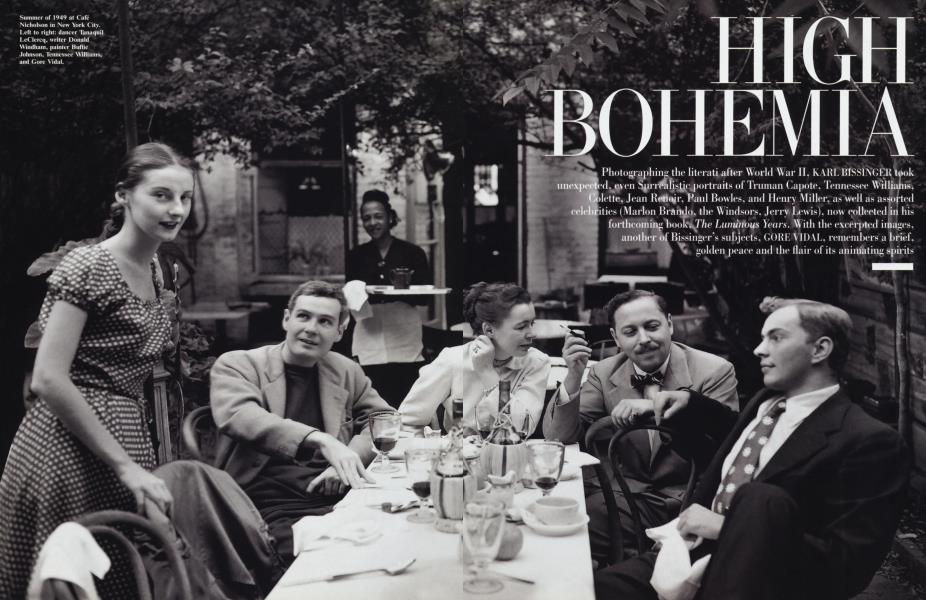
Photographing the literati after World War II, KARL BTSSINGER took unexpected, even Surrealistic portraits of Truman Capote, Tennessee Williams, Colette, Jean Renoir, Paul Bowles, and Henry Miller, as well as assorted celebrities (Marlon Brando, the Windsors, Jerry Lewis), now collected in his forthcoming book, The Luminous Years. With the excerpted images, another of Bissingers subjects, GORE VIDAL, remembers a brief, golden peace and the flair of its animating spirits
One warm New York day in 1949, Tennessee Williams, whom I had met the previous summer in Italy, and I were approached by an editor for a new magazine called Flair, the invention of Fleur Cowles. Would we allow Karl Bissinger to photograph us in the patio garden of Cafe Nicholson, along with ballerina Tanaquil LeClercq, painter Buffie Johnson, and Tennessee's old friend writer Donald Windham? For more than a halfcentury, whenever anyone asks me about the postwar 1940s and what it was like, I always say look at Karl Bissinger's photograph of us in the first issue of Flair There we all are. And such is the magic of his art that, though we are shown in black and white, the encompassing light appears golden. And we are young. We had survived the Depression and World War II. We had also flourished during the three years of peace prior to the photographyears that we assumed were prelude to a golden age, never suspecting that only a year later the Korean War would begin and the gold would go out of the light. A near century of perpetual war has made Bissinger's study oddly haunting. We are figures from a long-ago time—more 1848 than 1948.
Did I suspect what was to come? Hardly. But I do notice in pictures from this period how I am always the one who is looking out of frame. At what? I still wonder.
Bissinger seems to have been court photographer to Truman Capote, easily the most photographed writer of our brief golden age. As I study his photographs of Truman, I am struck by how expressionless Truman is. In life he was an ardent, if not always reliable, gossip with a most animated face. Here he looks strangely blank. Then I recall his fantasy of himself that sea-
son. When he told me that his new novel (never written) would be about a beautiful New York debutante, I asked, "What on earth do you know about them?" "Everything," he said, tossing his head. "After all, I am one." He had also picked up a mannerism reminiscent not so much of debutantes as of the great models and other beauties: a total blankness of expression. (Check out Ingrid Bergman's last close shot in Casablanca, where she hasn't yet been told how the picture ends.) Happily— or unhappily—most of Bissinger's subjects have been let in on that great mystery by now, and soon the rest of us ...
Bissinger deals in high Bohemia, the world of the arts, as well as strange celebrities like the Windsors. Here is Henry Miller in his Chinese-mandarin phase. The truly glamorous Jean Marais is seated on the sink of what looks to me to be the kitchen in the Palais Royal flat he shared with Jean Cocteau, a row of homely French detergents back of him and a worried frown betraying a domestic side Cocteau never captured in his movies. Colette is, as always, magnificent with hard carven features, not unlike a masculine Cocteau.
Photographed from the front, Jean Renoir has a shiny bald head while a mirror just back of him shows what looks to be, disturbingly, a full head of hair. We are in Magritte-land. Renoir reads a paper, morning coffee before him. We have the sense of ritual enactment. A demitasse. A white marble table. Surrealism is alive in these pictures: life, too. The mood even rubs off on Dean Martin and Jerry Lewis, who first joined forces in 1947. Bissinger's camera makes them mysteriously handsome, which their comedy could not. Or, perhaps, one should say comedy requires an element of the grotesque that Bissinger's eye ignores when it is not staged for him. He shows us only what's there, particularly if it's unexpected. Hoagy Carmichael sits at a piano and looks like the songs he writes. We see Montgomery Clift before his face was half paralyzed in an automobile accident. I wrote the screenplay for Suddenly Last Summer; when the producer, Sam Spiegel, heard that I was going to be at a party with Clift at Norman Mailer's, where we read Norman's play The Deer Park, Spiegel said: "Watch him like a hawk. Tell me if he gets drunk. We can't have that on this picture." I watched him like a hawk. He got drunk. I told Sam, "He drank only Coca-Cola." On the picture he could not work after lunch—painkillers, not alcohol. Joe Mankiewicz, for some reason, hated him, and in one scene Monty must hold a document and read from it. His hand shook so that the sound effect was like that of a forest fire. Joe made him shoot the scene a dozen times.
Bissinger seems to have been court photographer to Truman Capote, easily the most photographed writer of our brief golden age.
Excerpted from The Luminous Years: Portraits at Mid-century, by Karl Bissinger, introduction by Gore Vidal, to be published in November by Harry N. Abrams Inc.; © 2003 by Karl Bissinger; introduction © 2003 by Gore Vidal.
In these early shots, James Baldwin is still very much the boy preacher.
Paul Bowles is his usual immaculate self in a Paris suit made in the 1930s. He smoked kif nonstop. From kif, he liked to say, came some of his most exotic work. Bissinger catches, in only one shot, that fugitive look of apprehension which appears more in his work than in his face. A claustrophobe, Tennessee Williams always feared suffocation. He strangled to death from inhaling the cap of a plastic spray bottle. "What one most fears," I wrote Paul, "must fearfully happen."
Here is Walter Lippmann, a family friend. I was once in the tailor's room at New York's Brooks Brothers store. Lippmann, in a new suit, was staring intently at his face in the mirror. Identity check? The last time I saw him and his wife, Helen, was in Rome. They were in a joyous mood. "Why so happy?," I asked. "Because," said Helen, "we have just decided that we are never, ever going to Japan." Walter nodded, "It has been the Sword of Damocles hanging over my head for half a century."
In these early shots, James Baldwin is still very much the boy preacher. The Duke and Duchess of Windsor are like exquisite museum dummies designed to show off costumes. Some of their many dogs look attractive. She was a 1920s-style wisecracking flapper. She made you laugh. He was dim. Bertie Wooster who had strolled by accident into history without Jeeves. She often used the tone of a dominatrix with him. "Pull up your socks, David," she shouted at one dinner party.
Tallulah Bankhead looks amazingly like my mother, a friend of hers as well as a fellow congressional flapper. Marc Blitzstein seems ready to start talking, often brilliantly. He is at the piano—writing the score of Regina! He was murdered by Portuguese sailors in Martinique. Here is Charles Boyer, a great actor in French (.Madame de ... ), if not English. I worked on Is Paris Burning? All the French stars appeared. At first, Boyer said no. Then he burst into tears. "I was not in France. I fled to America." But he was in the picture. Marlon Brando is unrecognizably thin, posed in a round porthole. There is a picture of a hard Spanish writer I much admired in the 1940s, Camilo Jose Cela. His novel The Hive still lives on in my head. A fascinating Piscatoresque photograph of choreographer Agnes de Mille at work. An unglamorous shot of Jose Ferrer, because comedy intrudes: he was a wit. When his wife's nephew George Clooney appeared in his first play, he ate up the proverbial scenery. When Uncle Joe came backstage, Clooney asked him what he thought. Joe was kindly. "Be very careful, my boy, when you chew scenery, because you never know where it has been." Alec Guinness is shown in sly good form. We were both involved in a bad film but remained amiable. I last saw him in London. He said he was moving from country to town, to the hotel where each of us stayed. "I'll see you tomorrow," he said. "No, I'm off to Pittsburgh." "Why Pittsburgh?" "I'm acting in a film called Bob Roberts." Guinness winced. Then, low husky voice, "How long will you be in Pittsburgh?" I said, "Two or three days." He was suddenly radiant. "Oh, a small part!"
Bissinger deals in high Bohemia, the world of the arts; here is Henry Miller in his Chinese-mandarin phase.
The poetic Robinson Jeffers is revealed looking suitably magnificent beside the Pacific, where he lived in a stone tower and wrote poems in which hawks—that looked just like him—constantly circled. He did a version of Medea for Broadway which starred Judith Anderson, who did quite a bit of scene chewing herself. As Anderson took her curtain calls, Joan Crawford walked up the aisle to the exit, saying to no one in particular, "I would have played it differently." But then, as she once chided a journalist, "whom is fooling whom?"
CONTINUED FROM PAGE 299
Subscribers have complete access to the archive.
Sign In Not a Subscriber?Join Now


