Sign In to Your Account
Subscribers have complete access to the archive.
Sign In Not a Subscriber?Join NowVirtuosic Pass
DANCE
Sally Sommer
Reflecting on her recent popularity, choreographer Trisha Brown muses: "It's wonderful and a little disorienting. I have SO much less experience with approval than I have with discourse and argument that bubbles come out of my ears when people lavish me with praise."
Brown began making dances in the 1960s, part of a generation of young choreographers, the Judson group, who were redefining ideas about dance and performance. In 1969 a throng of dance devotees stood in a small Manhattan courtyard cheering Brown's newest piece, Man Walking Down Side of Building. Dressed in street clothes and mountain-climbing gear, a man languidly fell over the edge of the roof of a sevenstory building. When perpendicular to the wall, he began a slow walk to the ground.
The following year, Brown founded her own company but continued to perform in unusual settings: on rafts in a pond, on piers on Staten Island, in museums, and in galleries. And although she was still working with ordinary movements, she was putting them together in dances entitled "Accumulations," arranged with the logic and precision of a mathematician. At the same time, Brown was beginning to explore virtuosic dancing. "Time was running out," she says. "If I was going to do it, I had to get to it. The great irony of Judson was the good joke they pulled on me: I happened to be a virtuosic dancer, and they said 'No' to virtuosity. I had this body capable of moving in ways that not even I fully knew— except that I tasted the rapture of that experience when I was improvising."
Then, in 1978, Brown burst forth with her virtuosic dance Watennotor, a stream of perpetual motion that looked natural, swift, and easy. Though technically difficult, it had the beguiling air of relaxed, everyday movement—walking, running, falling—which soon became her trademark. The next year Brown began the first of many collaborations with visual artists and musicians.
In 1983, audiences in sold-out houses across Europe and America cheered Brown's Set and Reset, with costumes and sets designed by Robert Rauschenberg and music by Laurie Anderson. The dance began with a delicate reference to that piece made fourteen years earlier: a dancer held high in the air, with her body parallel to the floor, slowly walked across an invisible wall.
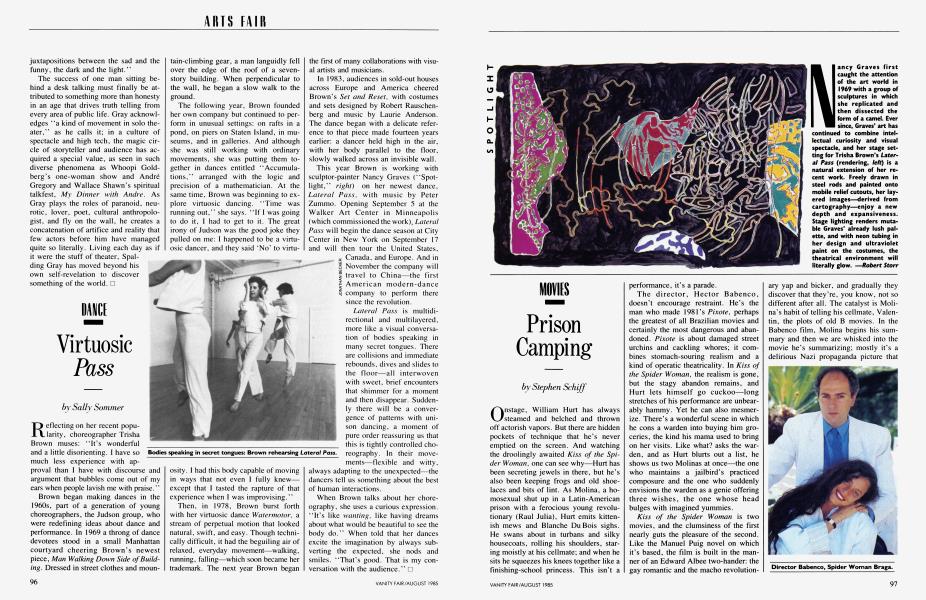
This year Brown is working with sculptor-painter Nancy Graves ("Spotlight," right) on her newest dance, Lateral Pass, with music by Peter Zummo. Opening September 5 at the Walker Art Center in Minneapolis (which commissioned the work), Lateral Pass will begin the dance season at City Center in New York on September 17 and will then tour the United States,
Canada, and Europe. And in November the company will travel to China—the first American modern-dance company to perform there since the revolution.
Lateral Pass is multidirectional and multilayered, more like a visual conversation of bodies speaking in many secret tongues. There are collisions and immediate rebounds, dives and slides to the floor—all interwoven with sweet, brief encounters that shimmer for a moment and then disappear. Suddenly there will be a convergence of patterns with unison dancing, a moment of pure order reassuring us that this is tightly controlled choreography. In their movements—flexible and witty, always adapting to the unexpected—the dancers tell us something about the best of human interactions.
When Brown talks about her choreography, she uses a curious expression. "It's like wanting, like having dreams about what would be beautiful to see the body do." When told that her dances excite the imagination by always subverting the expected, she nods and smiles. "That's good. That is my conversation with the audience."
Subscribers have complete access to the archive.
Sign In Not a Subscriber?Join Now