Sign In to Your Account
Subscribers have complete access to the archive.
Sign In Not a Subscriber?Join NowThe golf panic is on
ROBERT SCOTT McFEE
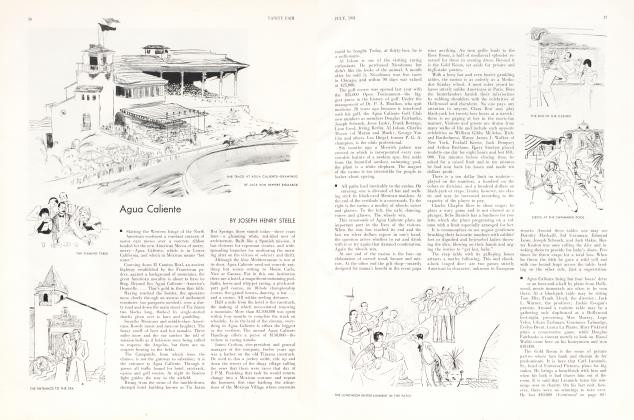
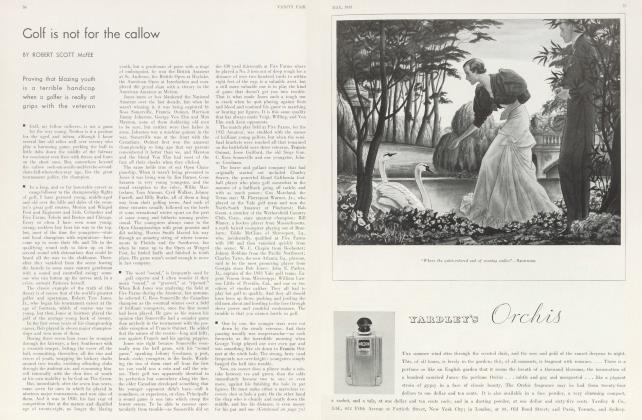
■ That mad rout tumbling over the green Inverness swells at Toledo, Ohio, pushing, shoving, scrambling, elbowing, is not the gallery pursuing the golfers. It is the golfers pursuing that ephemeral bauble so wearily set aside by Robert Tyre Jones—the Open Golf Championship of these United States, the title and all the delightful little perquisites that go with it: the autographing rights, the selling rights, the instruction rights, the exhibition rights, the indorsement rights and the rights to father articles for large sums of money, which will be syndicated for even larger sums.
In the lead, puffing slightly, his stout face a trifle red from the exertion, I see the chubby Macdonald Smith; and the stocky Gene Sarazen, a trifle more chunky than before; the gaunt, lean Tommy Armour, slim and dour; and the green eyed, explosive Leo Diegel. There they go abreast (the four greatest golfers in the country now that Jones has retired), trying to remain unhurried and dignified about it all, but very anxious each to outscramble the other.
Stepping on their heels are such celebrities as Whiffy Cox, who is said to have earned his sobriquet by having once taken a gratis and wholly ineffectual swipe on a tee in an open championship; Horton Smith, who Gan win winter tournaments but not summer'ones; Johnny Farrell, who always wins the prize offered for the best dresser, and who once licked Bobby Jones in open combat; the Turnesa boys: Jose Jurado, the Argentinean; Harry Cooper, who plays in hard luck; Wild Bill Mehlhorn, who amassed himself a ten on the sixth at Winged Foot in an Open and then went gaily off, laughing back over his shoulder—"Well, that's the handicap I'm spotting the field"; Charles Lacey, the Englishman, and Dinny Shute. Did I leave out Walter Hagen? I shouldn't. No one can leave Hagen out of the reckoning until Hagen cuts off both arms and one leg. And then he would probably bang the ball out of the rough with his crutch a good deal more skilfully than most youngsters can hit it today with a niblick.
■ Behind them gallop the rest of the crew, thrashing, hacking, hooking, bringing up the rear in the mad golf rush to stake out the claim vacated by the greatest player the world has ever known. Each has his hopes and ambitions of getting down in front. But against that first four, they are hundred-toone shots.
For the first time in many years, the country's best golf professionals will play their games in the Open Championship without figuratively turning up their coat collars against the chill presence of the Great One, somewhere on the links performing his miracles. Even now they will suffer a slight recollective shudder each time a Boy Scout or messenger comes a-galloping over the lea. He might still unburden himself of the dread news that that Jones boy had got back in the tournament, and just rounded the turn in thirty-two. But it won't happen. This time they have nothing but one another to beat and that lies within the bounds of their capabilities.
The fight for the title staged by those first four this month will be worth watching— four different temperaments playing for the first time without the Jones mental hazard. Cut the top man (that same Jones) from last year's British and American Open and right underneath you find Macdonald Smith. It took the Jones kind of golfer to beat Mac, the fellow who will run wild and shoot four or five threes in a row. The easy-going Mac Smith just plays par golf. He drives a straight one down the middle. He sticks the next one somewhere on the green. He takes the two putts allotted. If you want to beat Mr. Smith, you must beat par. Mac and par are just like that—buddies. That is what puts the pressure on. There you are, for instance, Mr. Erratic Star, fighting the golf course, slipping one over, getting back with a brilliant birdie, scoring an eagle and then blowing the two strokes with a bender out of bounds. And there too, somewhere over a hill, walks old Mac, unconcernedly shooting 5-4-4-3-4, etc., as called for by the card. That kind of thing gives a man the jitters.
■ It takes a genius to beat golf of this type. Leo Diegel has the genius. A wild, fiery, moody, crazy boy, the inventor of his own style of hitting and putting, he is quick, nervous and as temperamental as a cinema actress. One moment the ball is his balloon, or better, his marble, running in a groove from tee to cup. His winged feet skim over the top of the grass. The next he is ankle deep in despond's thickest slough, trying to play a cannon ball with a fly swatter. His motions are quick and jerky, his speech a slow drawl. He conceals weird lights in his sea-green eyes. Highly emotional, he wept with Von Elm when they each in turn blew the British Open two or three years ago. But when his genius is flickering he will turn in a sixty-six or -seven as easily as a seventytwo. If you could tie up one of his amazing rounds with a pair of seventy-fives and a round of par, who would beat him? Amazing Diegel—often a bridesmaid but never a bride —he's due. The steady ones will have his erratic flights of pure golfing genius to beat this year.
Take Gene Sarazen. (Try and take him.) The toughest, cockiest little golfer who ever twisted his spikes into the turf and hammered one for 260, he is short, stocky, square faced. He is built close to the ground on the general lines of a wing chair. He gets power into his shots by rolling his right under and thrusting with his right arm the way a fighter punches with an uppercut. He knows more about the game of golf than anyone would suspect. He plays the wind, the terrain, the air currents, the thickness of the turf and the quality of the grass, the consistence of the earth, the hent on the greens and sometimes, watching him, I think the moisture content of the atmosphere and the specific gravity of the cover of the ball. He will change clubs two and three times before making a shot, weighing every possibility and all hazards and then pick the right one.
Like most golfers he is superstitious. At Winged Foot he had the Open once more in his stubby fingers when he turned in a pair of 72's the first two days. As he walked to the 18th green the morning of the final day, his hall lay on the putting carpet in seventy-three.
(Continued on page 78)
(Continued from page 47)
"I had a seventy-five in the morning when I won my Open Championship at Shokie, after a pair of seventy-twos. I can't lose now. I'm as good as in. It's the same score." He stepped onto the green and flicked his approach putt to within eight inches of the cup for his seventy-fourth. His seventyfifth stroke was so easy that he tapped it carelessly and watched it aghast as it quit on the rim of the cup and didn't go in. Instead of his lucky seventy-five he took a seventy-six. It convinced him that he wasn't meant to win and he didn't. But in his swaggering moods when the shots are pouring out of his clubs, he believes no one can heat him, and very few can. He is hot for another championship.
They call Tommy Armour the Black Scot. His hair is black streaked with gray won in the British trenches along with his decorations and rank of Major. He wears black hose and sweaters, his mien is dark, a veritable Armour Dhu but his golf is all gold. Such is his mastery of the iron-tipped clubs that it blinds critics to the fact that he is also one of the greatest wood players in the game today. His midiron fade inside a ten foot circle around the pin is so spectacular that the gallery forgets the powerful and perfectly placed drive that put him in the position to bite the turf with his accurate iron, instead of having to apply himself to his brassie or spoon. He is as lean as a racehorse and has some of the thoroughbred's temperament. So finely balanced is his golfing machinery and so sensitive his nervous system that he may he thrown out of gear temporarily, often with damaging results. He once had a six-stroke lead on the field in a 10,000 dollar Open Championship when Mac Smith caught him in a had round and beat him by two strokes. He has been Open, Canadian and Professional champion, and is a good ten to one shot against the field. Coupled with the Vanity Fair Stable, Mac Smith, Sarazen and Diegel, he is as good as four to one.
The prize might escape the big four. Whiffy Cox has played great golf on the winter wheel. He is a master putter and one of the longest drivers in the game. But the third round has been his undoing. Mehlhorn, a hard, boisterous, truculent golfer is liable to bustle through. Horton Smith's beautiful style and rhythmic three quarter and half swings always wait until the National Open to desert him. The Turnesa boys play great rounds in the minor tourneys and are waiting to click in the big ones, particularly the slim Joe. Hagen is liable to spreadeagle the field. If an amateur gets up in the first ten it will be almost a miracle.
It will be a wild, hysterical, cutthroat tournament. Heretofore the reporters who have covered it have had it easy. The Messrs. Grantland Rice, Trevor, Alan Gould, Powers, and their colleagues merely set their noses to the Jones trail. This year with ten potential winners, they will run themselves ragged trying to be in at the death. The last two hours of the show I can particularly commend to any lunacy commission. For that is the time when the Open Championship suddenly becomes poison tothe players who seem to have a chance to win it. They hurl the thing from one to another, they kick it about like a football, it perches on their shoulders, and they knock it off. Weary, semi-hysterical, their nerves frazzled, they come into the last mad dash for the wire when some wide-eyed, breathless numbskull tells one of them that he needs only a 5-4-4-4 or one over par to win. Immediately he succumbs to the jeebies and cards 6-5-4-5, throwing the tournament into the lap of the next incoming candidate who juggles it, fumbles it, drops it and finally beats it to death in a trap, until finally some last hero is found who cannot get rid of it in spite of himself, and who manages to stagger home to collect the plaudits, the laurel and the cash.
Subscribers have complete access to the archive.
Sign In Not a Subscriber?Join Now
