Sign In to Your Account
Subscribers have complete access to the archive.
Sign In Not a Subscriber?Join NowE-String
How Princess Sungold Managed to Find a New Chord in a Melody of Love
ALBA NEVIS
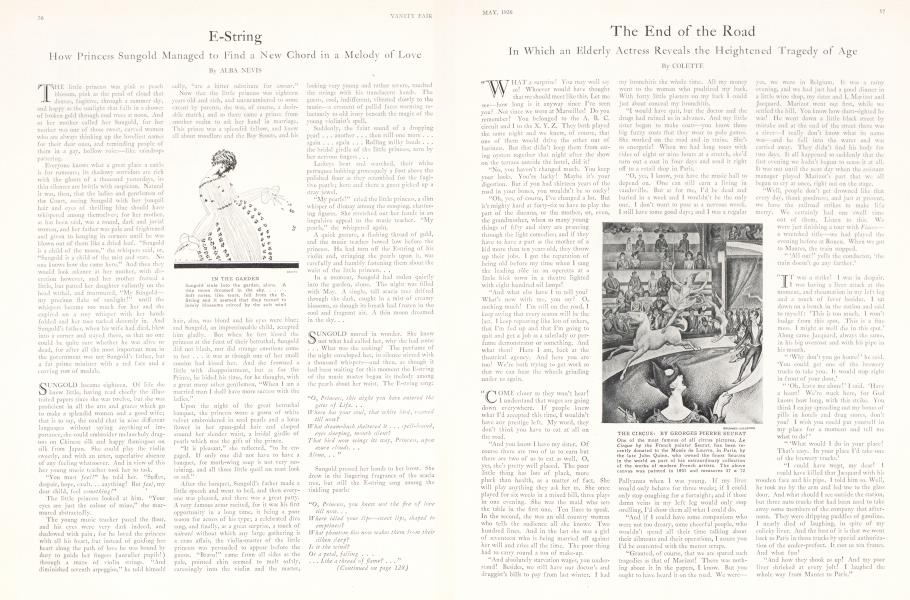
THE little princess was pink as peach blossom, pink as the petal of cloud that dances, fugitive, through a summer sky, and happy as the sunlight that falls in a shower of broken gold through cool trees at noon. And so her mother called her Sungold, for her mother was one of those sweet, curved women who arc always thinking up the loveliest names for their dear ones, and reminding people of them in a gay, hollow voice—like raindrops pattering.
Everyone knows what a great place a castle is for rumours; its shadowy corridors are rich with the ghosts of a thousand yesterdays, its thin silences arc brittle with suspicion. Natural it was, then, that the ladies and gentlemen of the Court, seeing Sungold with her jonquil hair and eyes of thrilling blue should have whispered among themselves; for her mother, as has been said, was a round, dark and jovial woman, and her father was pale and frightened and given to hanging in corners until he was blown out of them like a dried leaf. "Sungold is a child of the moon," the whispers said, or, "Sungold is a child of the mist and stars. No one knows how she came here." And then they would look askance at her mother, with discretion however, and her mother fretted a little, but patted her daughter valiantly on the head withal, and murmured, "My Sungold— my precious flake of sunlight!" until the whispers became too much for her and she expired on a rosy whisper with her hands folded and her toes tucked decently in. And Sungold's father, when his wife had died, blew into a corner and stayed there, so that no one could be quite sure whether he was alive or dead, for after all the most important man in the government was not Sungold's father, but a fat prime minister with a red face and a curving row of medals.
SUNGOLD became eighteen. Of life she knew little, having read chiefly the illustrated papers since she was twelve, but she was proficient in all the arts and graces which go to make a splendid woman and a good wife; that is to say, she could chat in nine different languages without saying anything of importance, she could embroider melancholy dragons on Chinese silk and happy flamingoes on silk from Japan. She could play the violin sweetly, and with an utter, superlative absence of any feeling whatsoever. And in view of this her young music teacher took her to task.
"You must feelP'> he told her. "Suffer, despair, hope, exult. . . anything! But feel, my dear child, feel something/"
The little princess looked at him. "Your eyes are just the colour of mine," she murmured abstractedly.
The young music teacher paced the floor, and his eyes were very dark indeed, and shadowed with pain; for he loved the princess with all his heart, but instead of guiding her heart along the path of love he was bound by duty to guide her fingers (unrulier pupils!) through a maze of violin strings. "And diminished seventh arpeggios," he told himself sadly, "arc a bitter substitute lor amour.
Now that the little princess was eighteen years old and rich, and unencumbered to some extent by parents, she was, of course, a desirable match; and so there came a prince from another realm to ask her hand in marriage. This prince was a splendid fellow, and knew all about woodlore and the Boy Scouts, and his hair, also, was blond and his eyes were blue; and Sungold, an impressionable child, accepted him gladly. But when he first kissed the princess at the feast of their betrothal, Sungold did not blush, nor did strange emotions come to her ... it was as though one of her small cousins had kissed her. And she frowned a little with disappointment, but as for the Prince, he bided his time, for he thought, with a great many other gentlemen, "When I am a married man I shall have more success with the ladies."
Upon the night of the great betrothal banquet, the princess wore a gown of white velvet embroidered in seed pearls and a lotus flower in her spun-gold hair and clasped around her slender waist, a bridal girdle of pearls which was the gift of the prince.
"It is pleasant," she reflected, "to be engaged. If only one did not have to have a banquet, for moth-wing soup is not very sustaining, and all those little quail on toast look so sad."
After the banquet, Sungold's father made a little speech and went to bed, and then everyone was pleased, and there was a great party. A very famous actor recited, for it was his first opportunity in a long time, it being a poor season for actors of his type; a celebrated diva sang, and finally, as a great surprise, a touch of naivete- without which any large gathering is a crass affair, the violin-master of the little princess was persuaded to appear before the guests. "Bravo!" came from all sides as the pale, pointed chin seemed to melt softly, caressingly into the violin and the master, looking very young and rather severe, touched the strings with his translucent hands. The guests, cool, indifferent, vibrated slowly to the music—a crescent of pallid faces warming reluctantly to old ivory beneath the magic of the young violinist's spell.
Suddenly, the faint sound of a dropping pearl . . . another . . . then still one more . . . again . . . again . . . Rolling milky beads . . . the bridal girdle of the little princess, torn by her nervous fingers . . .
Lackeys bent and searched, their white perruques bobbing grotesquely a foot above the polished floor as they scrambled for the fugitive pearls; here and there a guest picked up a stray jewel.
"My pearls!" cried the little princess, a slim whisper of dismay among the stooping, chattering figures. She stretched out her hands in an impulsive appeal to the music teacher. "My pearls," she whispered again.
A quick gesture, a flashing thread of gold, and the music teacher bowed low before the princess. He had torn off the E-string of his violin and, stringing the pearls upon it, was carefully and humbly fastening them about the waist of the little princess. . .
In a moment, Sungold had stolen quietly into the garden, alone. The night was filled with May. A single, tall acacia tree drifted through the dark, caught in a mist of creamy blossoms, as though its breath had frozen in the cool and fragrant air. A thin moon dreamed in the sky. . .
SOUNGOLD moved in wonder. She knew not what had called her, why she had come . . . What was she seeking? The perfume of the night enveloped her, its silence stirred with a thousand whispers—and then, as though it had been waiting for this moment the E-string of the music master began its melody among the pearls about her waist. The E-string sang:
"O, Princess, this night you have entered the gates of Life. . .
Where has your soul, that white bird, roamed till now?
What dream-hush sheltered it . . . spell-hound, eyes sleeping, mouth silent?
That bird now wings its way, Princess, upon azure clouds. . .
Alone. . . "
Sungold pressed her hands to her brow. She drew in the lingering fragrance of the acacia tree, but still the E-string sang among the tinkling pearls:
"O, Princess, you knew not the fire of love till now. . .
Where idled your Ups—sweet lips, shaped to emptiness?
What phantom kiss now wakes them from their silken sleep?
Is it the wind?
Or a petal, falling . . .
. . . Like a thread of fame? ..."
Continued on page 128
Continued front page 56
Sungold trembled ... a drooping blossom brushed its cool wings across her cheek . . . and still came the keening melody of the violin string:
"O, Princess, were your eyes blind, your ears unheeding?
Your heart a cruel fortress gate? Could you not know him plead for you? His heart bleed for you?
You never knew yours was his breath, his life . . .
. . . His music . . .
Princess this love came not from the mansion of the Prince /"
The melody died in the scented air, and in Sungold's heart a white pain was born as she recalled the music master's face, stern and sad, and the question in his eyes as he had stood beside her, guiding tenderly her delicate fingers. How tremulous his hands had been, worshipful as to an idol! How he had swayed and dreamed to the music, breathless with the ecstasy of its sound. She could feel once more his touch against her body as he placed around her waist the girdle, his fingers, in that one gesture, weaving about her the silken web of his own deathless love!
Like a slim, questing figure in a dream, Sungold moved forward. Her eyes were closed. She raised her arms to the soft sky, and whispered, "Now he must feel that I am waiting for him! He must come—and we shall be alone together in this dream. . . ."
1'he grass stirred . . . and from the castle there came the sound of laughter, the small tinkle of clapping hands. Sungold stole to the long window and looked through, pressing her cold hands to the cold glass. . . .
The music master, in a burst of jewelled light from a hundred glittering chandeliers, was playing to the guests. His fine brow gleamed above the polished wood of the violin; his hand, azure-veined and lightly curved, flashed like a bird among its golden strings, fashioning' from them the fabric, warm and throbbing, of a love-song. Like a fragrance, the music drifted about the room, colouring it, waking it to life; like a whisper, it echoed upon the warm wind that stirred from the garden, then, deepening, surged against the walls of the room and broke again, in opalescent waves, upon the still air. It seemed to come, this song, not only from the trembling strings of the master's violin, but from the stars, from the dreaming moon, from the very hearts of those that listened— so that an elderly Duchess was visibly affected and the Prime Minister's curving medals swelled anew with unaccustomed emotion.
"What is it?" the guests murmured, "what is this melody which the young music master of the Princess plays to us?"
Sungold listened at the window. . . . Her eyes filled with tears as she touched, with pale fingers, the E-string still fastened about her waist. . . . Then, with a sob, she tore it from her and flung it on the cool untroubled grass. . . .
Within the castle walls, a crashing discord sounded—then a single, sobbing note as the bow fell, powerless, from the young violinist's hand. Around him a hushed, a different silence fell, then swift voices murmured in distress; thin, puzzled brows were raised, sudden and stark as gibbets.
"Look at the music master! Why, he has gone quite white. . . . What is the matter. . . . What has happened. . . . Look at the music master. . . ."
In the garden, the moon had strayed behind a cloud and left only a mocking pin-point of light in its path. The night was still. . . .
. . . And the Princess Sungold was alone. '
Subscribers have complete access to the archive.
Sign In Not a Subscriber?Join Now
